Film music gets an extra dimension
Music has been accompanying films since the late 19th century. At the first film screenings, it wasn’t common to combine moving images with recorded sound. For these silent films, live music was often played by a pianist or a small ensemble. Some cinemas even had their own orchestra. In films by people like Charlie Chaplin, music helped tell the story and convey emotions without spoken dialogue.
The Golden Age of Hollywood
At the end of the twenties, the talking picture broke through. This put the film industry into overdrive, and it became increasingly important to compose music specifically for films. A period known as The Golden Age of Hollywood began.
This period, during which Hollywood grew into the center of the American film industry, roughly spanned from the 1920s to the 1960s. Historians disagree on the exact start and end dates. Five major film studios, ‘The Big Five’, dominated the industry: Metro-Goldwyn-Mayer (MGM), Paramount Pictures, Warner Bros., 20th Century Fox, and RKO Pictures. Film music also developed significantly. Composers increasingly wrote original music for specific films, also called original scores.
Different styles
Besides classical orchestral music, jazz, blues, and later pop music also started playing a bigger role. Composers experimented with new sounds and moved away from the traditional approach more often. For example, they combined orchestral music with electronic sounds, noise, and other experimental elements. Thanks to the rise of LPs and later CDs, complete movie soundtracks could be released on their own and started to take on a life of their own.
Synthesizers also offered new possibilities. With electronic instruments, composers could create a wide range of sounds and produce complete pieces of music. Nowadays, film music consists of a broad range of styles. The soundtrack often forms an essential part of a film’s identity.
A new dimension in experience
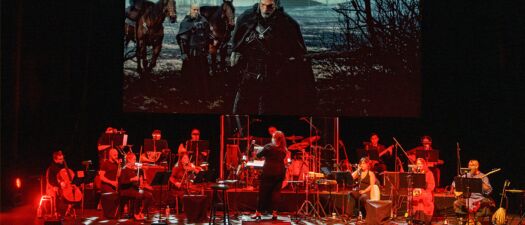
During various concerts, film music takes center stage. Popular soundtracks are performed live by bands and orchestras, sometimes while footage is shown on a big screen. This way, familiar stories and compositions gain a new dimension.
John Williams and Hans Zimmer are among the big names in film music, each with their own recognizable sound. Well-known works by these composers, including music from Gladiator and Jurassic Park, can be heard on Thursday, April 1, 2027, at Muziekgebouw Eindhoven.
Twilight in Concert is also happening on Tuesday, October 20, 2026. The first film will be shown on a big screen, while a twelve-piece ensemble plays the original film music live. Romeo + Juliet in Concert also combines film and live music. On Sunday, October 31, 2027, the film will be screened on a big screen, accompanied by a live band playing the soundtrack in sync with the visuals.
More than just film
Music also plays an important role in games. During The Witcher in Concert, the music from the popular game The Witcher 3: Wild Hunt takes center stage. The compositions by Marcin Przybyłowicz and the contribution of the Polish folk metal band Percival Schuttenbach bring the world of Geralt of Rivia to life.
Although the concerts differ a lot from one another, each performance focuses on the connection between music and story. For fans, they are an opportunity to experience their favorite movie or game in a new way. Whether visitors come for a beloved soundtrack, a special film experience, or the power of live music, every concert lets you experience familiar productions in a different way.