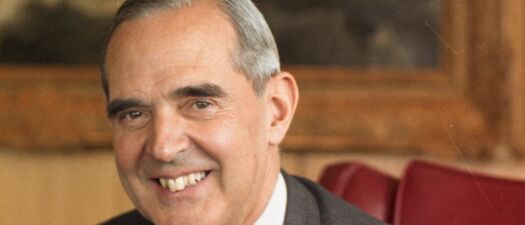
‘Meneer Frits’ Philips is closely associated with Muziekgebouw Eindhoven
In the 1960s, under the leadership of Frits Philips, Philips grew to become one of the largest technology and electronics companies in the world. The company expanded significantly on an international scale and earned a reputation as an innovative and forward-looking enterprise. Yet, Frits Philips was more than just a scion of the Philips family standing at the helm of the conglomerate. Simultaneously, he remained closely connected to ‘his’ Eindhoven. He believed that a strong company and a strong city should mutually reinforce one another, and he actively dedicated himself to social and cultural development. To him, the city was more than a mere business location; it was a community that needed to remain vibrant and inspiring. This commitment earned him the nickname ‘Meneer Frits’ in Eindhoven.
Muziekcentrum Frits Philips
When construction of the Muziekcentrum – as Muziekgebouw Eindhoven was known until 2010 – began on 22 June 1990, Frits Philips ceremonially lowered a concert grand piano into the building pit as an unofficial starting signal. He did this together with Hein Jordans, the former conductor of Het Brabants Orkest (now Philzuid, still the resident orchestra of Muziekgebouw Eindhoven). On 6 September 1991, the Muziekcentrum was symbolically handed over to the then Philips president Jan Timmer. On that occasion, Mayor Van Kemenade announced that the new concert hall would be named “Muziekcentrum Frits Philips”.
Van Kemenade said: “We believe that there is no better way to express our appreciation for the significance of Philips to Eindhoven over the past hundred years than by linking the name of Philips to a facility that symbolises the city’s development in the decades to come. In doing so, we honour the company, and in particular the man who for so many years has embodied the bond between the city and the company. In many respects, Frits Philips still does so today. He is not only a great industrialist, but also a genuine human being and a true citizen of Eindhoven.”
Frits Philips on the naming
‘Meneer Frits’ also commented on the fact that his name would appear on the façade of Eindhoven’s Muziekcentrum: “Traditionally, more music has always been made in Brabant than in other provinces; in many villages there were enthusiastic church choirs. At the beginning of the last century, intellectuals from all over the Netherlands came to work at Philips, and many of them had a strong desire to make and listen to music. I have found that people with a scientific background are often very musical. Various music societies emerged, such as the Philips Orchestra and the Philips Philharmonic Choir, which sang so beautifully at our wedding in 1929.”
Concerts were also regularly organised in the Philips family home, Frits Philips recalled: “I remember that even before the First World War, my parents and other Eindhoven families organised chamber music evenings in winter. The only suitable venue at the time was the Chicago cinema. The best seats in the hall were on the balcony, and for our concerts these were moved to the first six rows. Famous musicians, such as the Polish violinist Bronislaw Huberman, would stay at our home, De Laak on Parklaan, because Eindhoven had no suitable hotels at the time. After the concerts, supper was served at our house, as the musicians preferred not to eat before performing.”
But it was not only established artists who made music there. “Music was very often made in our home by my mother, who was quite an accomplished pianist. Every Wednesday afternoon, for example, Beethoven sonatas would resonate through the house while I did my homework. She played together with well-known musicians such as Spaanderman and Van Beinum.”
When Eindhoven grew in the 1920s, there was a need for a suitable venue for theatre and musical performances. Frits wrote: “The Philips Recreation Centre was not originally intended for that purpose. It initially served as a canteen, as employees who were often recruited from as far away as Belgium needed a place to spend their hour-and-a-half break. Its location between the Strijp and Emmasingel factory complexes was ideal. Only in 1934 was the hall converted into a theatre with a balcony. The acoustics, however, always left something to be desired, although they were considerably improved by the installation of an electronic reverberation system. Nevertheless, it is far better when acoustics are naturally good.”
“When we lowered a concert grand piano into the building pit of the Muziekcentrum last June, I said that it is of the utmost importance that musicians and conductors together ensure high-quality music. The combination of excellent performers, an acoustically outstanding hall and the expertise we have developed in Eindhoven to record music almost perfectly on compact disc makes it possible to distribute Eindhoven’s musical products all over the world. It is good that the new Muziekcentrum bears a well-known name that also sounds familiar to people abroad. When artists say they have performed at the Muziekcentrum Frits Philips, the name means something to people, and that is pleasing for the artists.”
He also saw this as an additional incentive for Het Brabants Orkest, for which he had always had a warm affection. “I have often greeted conductor Hein Jordans in his dressing room during the interval of a concert and told him how much we enjoyed his music. But I do believe that Het Brabants Orkest must continue to work on strengthening the good reputation of the Muziekcentrum by playing excellently. Fortunately, that no longer depends on me, because at my age there is not very much you can still do wrong.”
Meneer Frits lives on
Today, the concert hall has long been known as Muziekgebouw Eindhoven; after a lengthy transition period, the name Frits Philips has disappeared from the brand. Restaurant Meneer Frits also closed in 2023 to make way for venue M. That does not mean, however, that this Eindhoven icon is no longer visible in the building. On the contrary: hundreds of visitors come into contact every day with the various tributes throughout the venue. There is now the Frits Philips Foyer, from which the intimate Small Hall can be reached. A bronze bust of Frits looks out over the visitors there. In the main Hertog Jan Hall there is also a tribute to the man who is inextricably linked to the building: one striking yellow seat, dedicated to Frits Philips. Have you ever sat in the yellow seat?
Photo: Koninklijke Philips N.V. / Philips Company Archives