The guitar might be the most versatile instrument, with a long history!
The oldest ancestors of the guitar originated in Central Asia and the Middle East. Instruments with a soundbox and a neck—precursors to the lute—were played there long before our era. In the eighth century, the Moors brought the oud to Spain, a pear-shaped string instrument. Over the centuries, the shape and function of the oud changed; it became smaller, flatter, and more practical.
Revolution
In the 19th century, a ‘guitar revolution’ occurred thanks to the Spanish guitar maker Antonio de Torres. He enlarged the soundbox, improved the internal bracing (the wooden reinforcement inside the soundbox), and thereby gave the guitar its distinctive shape. Torres’ design resulted in more volume and a richer sound. Virtually every classical and acoustic guitar built today is indebted to his design.
When the guitar arrived in the United States, the context changed again. In cafes and dance halls, the traditional gut-stringed guitar proved to lack sufficient volume. Steel strings offered a solution. The sound became clearer and more powerful. This gave rise to the Western guitar as we know it, and with it, the characteristic sound of the blues. Musicians like Robert Johnson discovered that a metal tube or a worn bottle neck across those strings could evoke a raw, gliding tone that has since been heard in many pop songs.
Electric guitar
However, the volume problem persisted whenever the guitar had to compete against brass instruments and drums. In the 1920s and 1930s, inventors began experimenting with magnetic pickups that could amplify string vibrations. When inventors like Leo Fender and Les Paul introduced the solid-body electric guitar in the 1940s and 1950s—a guitar without a hollow soundbox, which greatly reduced the high-pitched squealing from the amplifier—the floodgates opened.
With the arrival of the electric guitar, the position of the guitar in the band changed drastically. Whereas the guitar previously served primarily as accompaniment, it could now carry the melody and hold its own against brass instruments and drums. In the sixties, Jimi Hendrix demonstrated that a guitar could not only sing, but also scream. In the eighties, Eddie Van Halen redefined what was possible on the guitar neck with his lightning-fast ‘tapping’ technique. That guitar evolution has never stopped, not even with the new generation emerging today. Think of the funk grooves of Cory Wong, the insane innovative technique of Matteo Mancuso—in 2024 he gave a masterclass and performed with his band at BRIDGE—the virtuoso Mateus Asato—who can be seen at Muziekgebouw Eindhoven on October 9—or St. Vincent, who uses the electric guitar as a futuristic synthesizer-like instrument. One thing is certain: as long as the musicians keep innovating, the guitar innovates along with them.
BRIDGE Guitar Festival Eindhoven
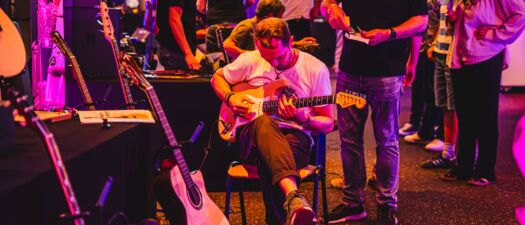
From Wednesday, May 27 to Sunday, May 31, 2026, that richness of the guitar will be celebrated during the fourth edition of BRIDGE Guitar Festival Eindhoven. As the largest and most diverse guitar festival in the Benelux, it connects genres, cultures, and communities, placing the guitar at the center as one of the world’s most played instruments. During the last edition of BRIDGE Guitar Festival Eindhoven, 16,000 guitar enthusiasts visited the festival, which consists of many activities at indoor and outdoor locations, such as concerts, workshops, masterclasses, and a large guitar fair. Moreover, part of the program is free to attend.
The free city festival BRIDGE Around Town features dozens of artists and bands, spread across various unique locations over two days. From the atmospheric Markt to intimate hospitality venues: the program promises a diverse mix of styles and surprises, turning the entire city into a celebration of guitar music. View the full program at bridgefestival.com.