Kraftwerk: revolutionary pioneers with close ties to Eindhoven
That makes Kraftwerk so special is that they saw the beauty in everyday, modern things. While other bands sang about love or distant travels, Kraftwerk sang about the down-to-earth reality of post-war Europe: driving on the Autobahn, traveling on the Trans-Europe Express, or the simple pleasure of a pocket calculator. They embraced technology at a time when many people still found it scary or cold. Through that focus on technology, they actually predicted forty years ago what our current world would look like. Their 1981 album Computer World was about data duplication, government computers, and digital communication, long before we all had a smartphone in our pockets.
Source of inspiration
Musically speaking, their approach was revolutionary in its simplicity. No unnecessary frills, just tight, hypnotic rhythms and crystal-clear melodies. That “robot pop” proved to be a massive source of inspiration for completely different genres. In the back alleys of New York, the first hip-hop artists used their beats as the foundation for a new music culture, while in Detroit, the pioneers of techno became fascinated by the mechanical precision coming out of Germany. Even major pop stars like David Bowie and Coldplay were happy to draw inspiration from Kraftwerk.
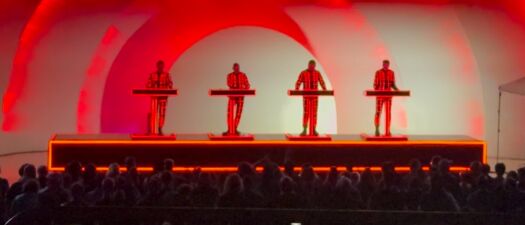
Today, their performances have evolved into a unique visual experience. Anyone attending a Kraftwerk show doesn’t see a traditional rock band, but four stately figures behind illuminated consoles, surrounded by advanced projections. It’s a total work of art that fits perfectly with a city like Eindhoven, where we’re accustomed to the combination of design, technology, and creativity.
Philips
Kraftwerk and Eindhoven go way back. If you look at the history of the city and the band, you’ll see several points of connection. While Eindhoven is the city of Philips and technological innovation, Kraftwerk is the band that translated that same innovation into music. They didn’t concern themselves with standard rock-’n-roll clichés, but became fascinated by the world of machines, computers, and electronics. That fascination had a direct, tangible link to Eindhoven. In their early years, Kraftwerk released their first three albums under the world-famous Philips label. The iconic album covers from that era bear the logo of the company that made Eindhoven great.
Philips’ equipment, the developments at NatLab, and the city’s early experiments with electronic music served as a massive source of inspiration for the band. Ralf Hütter and Florian Schneider, the founders of Kraftwerk, weren’t the type to rebel against the established order. They were more like musical engineers; they used the technology developed in factories and laboratories to create a whole new kind of pop music.
Evoluon
The highlight of this special bond between the city and the band was their 2013 concerts at the Evoluon. This building is, of course, the ultimate symbol of progress in Eindhoven. It was no coincidence that Kraftwerk performed there. The Evoluon’s “UFO” already looked like the future back in the 1960s, and Kraftwerk’s music did exactly the same. During those shows, everything came together: the history of the Philips label, the futuristic architecture, and the band’s electronic beats. People who were there often describe it as a moment when the character of the city and the music fit together perfectly. That’s why a visit by Kraftwerk to Eindhoven still feels like a homecoming of sorts.
On Thursday, June 11, Kraftwerk returns to Eindhoven for an exclusive concert. The Klokgebouw at Strijp-S provides the industrial backdrop for this concert, a special venue for the band as they return to their earliest roots. Their first albums were released on the Philips label, and at the time, the Klokgebouw was part of the industrial complex of the Eindhoven-based electronics company.